It's Not Your Fingers: The Real Reason Chopsticks Feel Impossible (And How to Fix That)
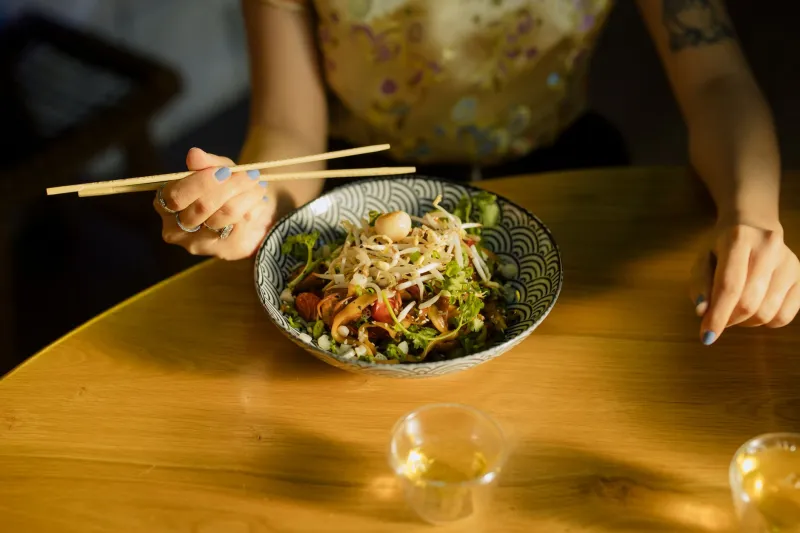
Here's a scene that plays out in Chinese restaurants across the country every single day. An American picks up a pair of chopsticks, wrestles a dumpling halfway across the table, laughs it off, and quietly asks for a fork. The table moves on. But somewhere in that moment, a small opportunity slips away — not just to eat more efficiently, but to connect with a culture that has been using these two sticks for over three thousand years.
The thing is, chopstick struggles aren't really about dexterity. Most people who can't get them to cooperate aren't clumsy. They're just working from the wrong mental model entirely.
The Fork Brain Problem
When Americans pick up chopsticks for the first time, they instinctively try to use them the way they'd use a fork — as a stabbing or scooping tool. That's the fork brain talking, and it's almost impossible to shut off without understanding why it's wrong.
Chopsticks aren't designed to carry food to your mouth the way a fork does. They're precision instruments built for a cuisine that was already portioned, bite-sized, and communal long before the utensil ever touched the table. Chinese food doesn't need to be cut because it was never plated in large, unbroken pieces to begin with. The chopstick's job isn't to stab or scoop — it's to pinch, guide, and transfer.
Once that clicks, the whole thing starts to make more sense.
What You're Actually Supposed to Do With Your Bowl
Here's something nobody tells Americans before their first trip to China: the bowl is part of the system. In Chinese dining culture, you hold your rice bowl close to your mouth and use chopsticks to guide food in — not to transport it across open air like some kind of culinary tightrope act.
Americans tend to leave the bowl on the table and try to chopstick food up from a distance. That's an incredibly hard thing to do, even for people who grew up using them. You're fighting physics. When you hold the bowl near your chin and use the chopsticks as a short-range guide, suddenly everything becomes dramatically easier.
Jessica, a teacher from Portland who spent six months in Chengdu, describes her breakthrough moment exactly this way. "I kept dropping things and getting frustrated," she says. "Then a colleague at lunch just casually picked up her bowl and I realized I'd been doing the whole thing wrong. Once I started lifting the bowl, it was like a switch flipped."
The Mechanics, Without the Jargon
If you want to practice before you land in Beijing or Xi'an, here's the clearest breakdown that actually works:
The bottom chopstick stays still. Always. Rest it in the groove between your thumb and index finger, supported by your ring finger. It does not move. Ever. If it's moving, that's your problem.
The top chopstick does all the work. Hold it like a pencil — genuinely like you're writing — and use your index and middle fingers to open and close it against the stationary bottom stick.
That's it. The whole system. The reason it feels hard at first is that your brain keeps trying to move both sticks, which creates a chaotic scissoring motion that sends food flying. Lock the bottom one down and everything changes.
Practice at home with something forgiving — grapes, large marshmallows, or even crumpled paper balls. Once you've got the motion, move to something smaller. Rice is the final boss. Don't start there.
The Mistakes That Actually Matter (Culturally Speaking)
Beyond technique, there are a handful of chopstick habits that don't just make you look inexperienced — they carry real cultural weight in China, and it's worth knowing about them before you sit down at someone's table.
Sticking chopsticks upright in a bowl of rice is one of the most commonly cited taboos in Chinese dining culture. The image mirrors incense burned at funerals and is associated with offerings to the dead. It's not a quirky superstition — it's genuinely jarring to see at a dinner table, and it will register with your hosts even if they're too polite to say anything.
Pointing at people with chopsticks reads as rude in a way that's hard to overstate. It's the equivalent of wagging a finger in someone's face during a conversation.
Passing food directly from your chopsticks to someone else's is another funeral association — it echoes a ritual performed during cremation ceremonies. If you want to share food, place it in the other person's bowl instead.
None of this is meant to make you anxious. Chinese hosts are overwhelmingly gracious with foreign guests, and genuine curiosity goes a long way. But knowing these things ahead of time means you can focus on enjoying the meal instead of accidentally creating an awkward moment.
Why It Actually Matters When You Travel
Mark, a software engineer from Austin who travels to Shanghai twice a year for work, put it plainly: "The first time I got through a full business dinner without asking for a fork, something shifted. My colleagues noticed. It wasn't a big deal, but it wasn't nothing either. It felt like I was actually showing up."
That's the thing about chopstick competence in China — it's not about impressing anyone. It's about showing that you came to participate, not just observe. Chinese food culture is deeply communal and tactile. Shared dishes, lazy Susans, family-style eating — all of it is designed around a specific way of engaging with the table. When you can move through that system naturally, you stop being a spectator and start being a guest.
And honestly? The food tastes better when you're eating it the way it was meant to be eaten. Mapo tofu scooped into a rice bowl and eaten in small bites hits differently than the same dish wrestled onto a fork.
Before You Board the Plane
A few weeks of casual practice at home will get you further than you'd expect. Order Chinese takeout and commit to chopsticks only — no fallback fork. Start with noodles (easier than they look), work up to tofu, and save the rice for when you're feeling confident.
You can also grab a set of training chopsticks with a connector at the top — they're sold cheaply on Amazon and are genuinely useful for building the right muscle memory without the frustration. Kids use them in China all the time, and there's zero shame in starting there.
By the time you're sitting down at a night market in Chengdu or a hotpot restaurant in Chongqing, you want the chopsticks to feel like second nature. Not because anyone is grading you, but because the moment you stop thinking about the sticks is the moment you start actually tasting the food — and noticing the people around you.
That's when the real trip begins.