After Midnight in China: Why the Night Economy Is Making Americans Rethink Everything They Know About Work
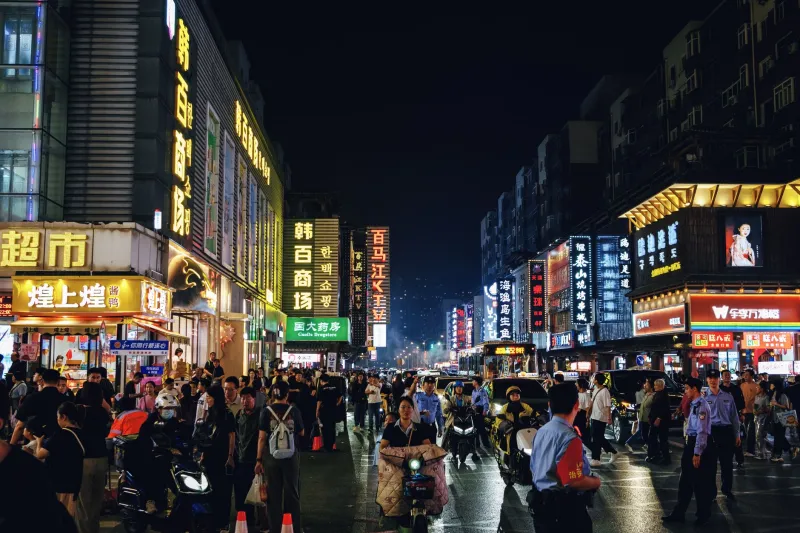
It's 1:30 in the morning in Chengdu. The streets outside your window are not quiet. They're loud in the best possible way — the sizzle of skewers hitting a grill, the clatter of mahjong tiles a few floors down, the distant hum of a convenience store that has been open since before you can remember and will still be open when you wake up. Nobody seems alarmed by this. Nobody is rushing home. The night, here, is not an ending. It's just the next chapter.
If you've grown up in the United States, where the default rhythm is something like: work hard from 9 to 5, eat dinner by 7, be in bed by 10 and feel vaguely guilty if you're not — China's relationship with nighttime can feel genuinely disorienting. Not in a bad way. More like the feeling of realizing there was a door in your house you'd never opened.
What the Night Economy Actually Looks Like
China's 夜经济 (yè jīngjì), or night economy, isn't a niche trend. It's a full-scale cultural and commercial infrastructure. In cities like Guangzhou, Xi'an, and Wuhan, local governments have actively invested in it — extending metro hours, lighting up riverside districts, and designating specific zones as late-night commercial areas. The idea is simple: if people want to spend money at midnight, give them somewhere to spend it.
Night markets are the most visible expression of this. Walk through any major Chinese city after 10 p.m. and you'll find food stalls selling everything from spicy crayfish to freshly pulled noodles, vendors hawking phone cases and vintage jackets, and clusters of friends who look like they have absolutely nowhere else to be. These aren't tourist traps, either. They're where locals actually eat, shop, and socialize — and they operate on their own clock, often peaking somewhere between 11 p.m. and 2 a.m.
Beyond the markets, there's a whole ecosystem of late-night services that would feel alien to most Americans. Twenty-four-hour barbershops. Midnight bookstores with reading nooks and espresso. Hot pot restaurants that fill up at 11 p.m. like it's prime time. Gyms that buzz with activity at hours when most US fitness centers have already locked their doors and set the alarm.
The Work Side of After Dark
Here's where it gets interesting for anyone who's ever felt strangled by a rigid 9-to-5 schedule. Some Chinese companies — particularly in tech, logistics, and e-commerce — have started formalizing what workers were already doing informally: shifting core hours later, offering overnight shift options, or structuring the workday around output rather than clock-punching.
This isn't the notorious 996 culture (9 a.m. to 9 p.m., six days a week) that drew so much criticism — and that criticism was valid. This is something different. It's the recognition that not everyone does their best thinking between 9 and 5, and that a city that never fully sleeps can support workers who operate on a different biological schedule.
Talk to expats living in Shanghai or Shenzhen and you'll hear versions of the same story. "I'm a night person," says Marcus, a graphic designer from Portland who's been based in Shenzhen for three years. "Back home, I felt constantly out of sync. Here, I work from about noon to 9 p.m., grab dinner at a place that's just hitting its stride at 10, and I actually feel like I'm living in my own time zone for once."
That flexibility — informal as it often is — has a measurable effect on how people feel about their days. When your city is alive at midnight, staying up late doesn't feel like a failure of self-discipline. It feels like participation.
What Americans Are Starting to Notice
The conversation around work-life balance in the US has been getting louder for years. Four-day workweeks, remote-first policies, asynchronous communication — all of it points to the same underlying frustration: the traditional American work structure wasn't designed around human beings, it was designed around factory floors. And a lot of people are tired of pretending otherwise.
China's night economy offers a different kind of case study. It's not about working less, necessarily. It's about decoupling productivity from a specific window of the clock. When a city functions at full capacity across a broader stretch of hours, individuals have more genuine choice about when they engage — with work, with food, with leisure, with other people.
For American travelers who spend any real time in China, this tends to land as a quiet revelation. You realize how much of your daily schedule back home is dictated not by preference but by the hours everything else is open. Your gym closes at 10. Your favorite restaurant stops seating at 9:30. The dry cleaner isn't open on Sundays. The city itself has a bedtime, and you've been living by it without ever consciously choosing to.
The Part That Doesn't Translate Perfectly
It's worth being honest about the tension here. China's night economy has real benefits, but it also exists partly because long working hours remain common — and the night market isn't just a lifestyle choice, it's sometimes the only hour a delivery driver or factory worker gets to themselves. The same late-night noodle stall that feels romantic to a foreign visitor is the only hot meal that a logistics worker on a split shift could realistically eat today.
That context matters. The goal isn't to romanticize exhaustion dressed up in fairy lights. It's to recognize that a society organized around more flexible time — where commerce, rest, and community aren't all crammed into the same narrow window — can create real breathing room for real people. The night economy works best when it's a genuine option, not a default condition.
Why It Stays With You After You Leave
Most American travelers who've spent significant time in China come home with a version of the same jet lag that isn't really about time zones. It's the adjustment back to a world that closes early and expects you to be fine with it.
You find yourself standing in front of a shuttered restaurant at 10:15 p.m. on a Tuesday, genuinely confused. You miss the freedom of deciding, at midnight, that you want noodles and knowing that somewhere nearby, someone is making them. You miss the feeling of a city that doesn't treat nighttime like a problem to be managed.
China won't change how you sleep. But it might change how you think about time — and whether the schedule you've been living by is actually yours.