Why Strangers in China Become Friends Faster Than Anyone You Know Back Home
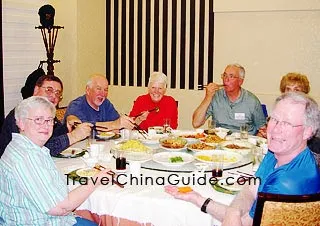
Photo: American traveler sharing meal with Chinese locals at restaurant table, via www.travelchinaguide.com
You're sitting at a small table in a Chengdu hotpot restaurant, shoulder-to-shoulder with a couple who waved you over fifteen minutes ago because your table for one looked lonely. You don't share a language beyond a handful of gestures and a translation app that keeps autocorrecting to something absurd. And yet, an hour later, you've somehow communicated where you're from, what your parents do, whether you're married, how much you earn, and what you actually want out of life.
That last part — that's the part that catches Americans off guard every time.
The Small Talk Problem We Didn't Know We Had
Back in the States, we've built an entire social architecture around avoiding depth. You talk about the weather. You ask how someone's weekend was without expecting a real answer. You say "we should hang out sometime" with no intention of following through. It's not malicious — it's just the cultural norm. Keep it light. Don't pry. Respect boundaries by never testing them.
China operates on a completely different frequency.
Chinese social culture doesn't really do small talk the way Americans do. When locals ask questions, they tend to ask real ones — your age, your salary, your relationship status, your family situation, your plans. To American ears, this can feel intrusive at first. But spend a few days sitting with it, and something shifts. You start to realize that being asked real questions means someone is actually interested in you as a person, not just filling conversational space until it's polite to leave.
That directness is disarming in the best possible way.
Curiosity as a Currency
American travelers — especially ones who don't look like they're on a tour group — draw genuine curiosity in China, particularly outside the major tourist centers. In a city like Xi'an, Kunming, or Guilin, running into a foreigner who's wandered off the beaten path and is clearly trying to engage with local life is genuinely interesting to people. You become a conversation worth having.
And here's where it gets interesting: that curiosity goes both ways. Most Americans who travel to China aren't doing it because it was the easiest option. They're doing it because they wanted something real. That intention is palpable, and locals pick up on it.
When you show up at a neighborhood dumpling spot with no translator and a willingness to point at things and laugh at your own confusion, you're signaling something. You're saying: I'm here for this, not for a sanitized version of it. That signal opens doors that no guidebook can unlock for you.
The Table Is the Relationship
If there's one thing that accelerates connection in China faster than anything else, it's sharing a meal — and not just eating in the same room. Sharing dishes. Pouring tea for the person across from you before you pour your own. Accepting the piece of fish someone has placed in your bowl without asking.
Chinese dining culture is fundamentally communal in a way that American restaurant culture simply isn't. In the US, we order our own food, we eat from our own plates, and splitting the bill is a whole negotiation. In China, the table is a collective experience. You eat from the same dishes. You toast together. You slow down.
That shared slowness creates intimacy. It's hard to stay guarded when someone keeps refilling your glass and sliding the best piece of meat onto your plate. There's a vulnerability built into the ritual that bypasses the usual social defenses.
More than a few American travelers have described sitting down to what they expected to be a solo dinner and ending up in a three-hour feast with a family who insisted on paying, then walked them back to their hotel, then texted them the next morning to make sure they'd found breakfast.
What Vulnerability Actually Looks Like Here
One of the quieter revelations of traveling in China is discovering what it feels like to be genuinely helped by a stranger with no transactional motive.
In American cities, accepting help from someone you don't know can feel complicated. There's an unspoken assumption that favors have a cost, that generosity comes with strings. In China — particularly with travelers who are visibly out of their depth — the impulse to help often seems to come from a completely different place. It's hospitality as a value, not a transaction.
When someone spends forty minutes walking you to a train station you couldn't find, or sits with you at a pharmacy to make sure you get the right medicine, or calls their English-speaking niece so she can translate your situation to a hotel receptionist — that's not small. That's the kind of thing that stays with you.
And the strange thing is, it tends to make Americans more open in return. Being on the receiving end of uncomplicated generosity has a way of softening the walls people didn't even know they'd built.
The Distance That Helps
There's also something to be said for the freedom that comes with being far from your regular life. In China, you're not somebody's coworker, neighbor, or ex. You're not carrying the social weight of your usual context. That anonymity is liberating in a way that makes people more willing to be honest — about who they are, what they want, what they're figuring out.
Locals often sense that openness and meet it in kind. Conversations go deeper faster because neither party has anything to protect. There's no professional reputation at stake, no mutual friend group watching, no LinkedIn connection to manage.
Some of the most honest conversations people have about their lives happen in train compartments and tea houses in China, with someone they'll likely never see again. And somehow, that makes it more meaningful, not less.
What You Bring Home
The connections Americans make in China don't always translate into lifelong pen pals — though sometimes they do, WeChat makes that easier than you'd expect. But what tends to come home with people is something more internal: a recalibrated sense of what friendship can feel like when it's not filtered through professional networking or social performance.
You come back with a lower tolerance for surface-level interactions. You find yourself asking people more direct questions. You linger a little longer at the dinner table. You notice when a conversation stays shallow and you start to wonder why you're both letting it.
China doesn't hand you a manual for better relationships. But it does show you, in small and repeated ways, what it looks like when people actually make time for each other. And once you've felt that, it's hard to settle for less.