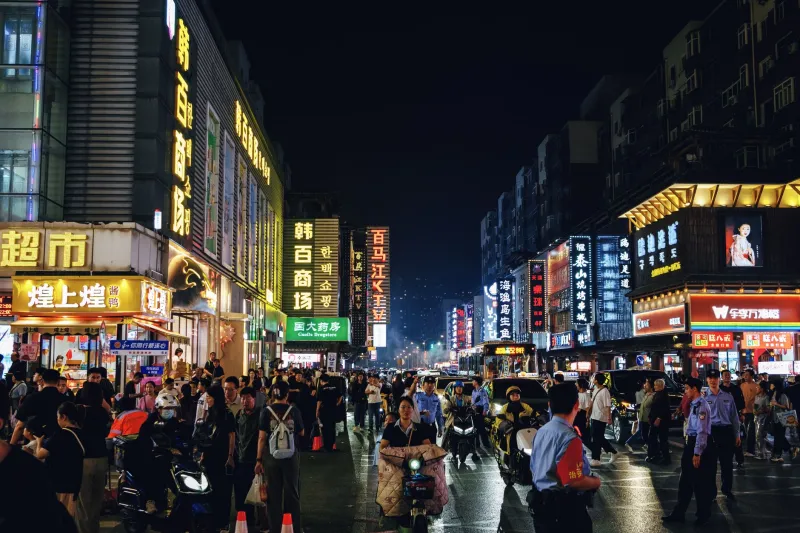
They Came for Two Weeks and Never Bought a Return Ticket

Jessica from Portland had a return flight booked. She remembers the exact seat number — 34B, window, United, connecting through San Francisco. She never used it.
That was six years ago. She now runs a small design consultancy out of Chengdu, has a Sichuan-style kitchen she's spent two years perfecting, and recently renewed her residency permit for the fourth time. When she talks about going back to the States, she uses the word "visit."
"I keep thinking I'll feel the pull," she says over a bowl of malatang on a Tuesday afternoon. "But every time I land in Portland, I spend the whole trip thinking about what I'm going to eat when I get back here."
Hers isn't a rare story. Across China — in the hutongs of Beijing, the café-lined streets of Yunnan, the gleaming tech corridors of Shenzhen — there are Americans who arrived with a duffel bag and a vague plan and ended up building something they didn't expect: a life.
The Two-Week Window That Changes Everything
Travel researchers have long noted that the first two weeks in a new country are the most disorienting. Your brain is working overtime. Everything is unfamiliar — the sounds, the food, the social rhythms. Most people white-knuckle through it, tick off the highlights, and go home relieved to be back on familiar ground.
But China, for a certain type of visitor, does something different during that window. Instead of exhausting you, it activates you.
Marcus, a former high school history teacher from Atlanta who's now been in Guangzhou for four years, describes it as a kind of sensory unlocking. "Back home, I knew every restaurant, every road, every conversation before it started. Here, I had no idea what was coming next. And instead of that terrifying me, it woke me up."
Psychologists who study expatriate behavior point to something called "novelty sensitivity" — the degree to which a person is energized rather than destabilized by unfamiliar environments. China, with its density of new experiences per square mile, tends to sort people quickly. Those with high novelty sensitivity don't just survive the initial overwhelm. They start craving more of it.
It's Cheaper Than You Think, and That Changes the Math
Let's be practical for a second, because the financial reality of living in China is something that genuinely surprises most Americans — and it's a huge part of why short stays become long ones.
In most major Chinese cities, a comfortable one-bedroom apartment in a central neighborhood runs between $400 and $800 a month. A full sit-down meal at a local restaurant? Often under five dollars. High-speed rail tickets between cities that would be a twelve-hour drive? Frequently under forty dollars. The cost of living, for someone earning even a modest income — teaching English, freelancing remotely, working for a foreign company with local operations — stretches in ways that feel almost surreal coming from the United States.
"I was spending half my Atlanta salary on rent alone," Marcus says. "Here, I have money left over at the end of the month. I travel on weekends. I've been to more places in Asia in four years than I visited in the US in my entire twenties. That's not nothing."
For Americans buried in student debt or priced out of homeownership back home, China offers something rare: the sensation of financial breathing room. And once you've felt that, it's hard to go back to barely keeping up.
The Community Nobody Warned You About
One of the quieter forces behind accidental long-term stays is the expat community itself — and the way it forms in China specifically.
Unlike in some countries where foreign residents cluster in insular bubbles, the expat scene in Chinese cities tends to be genuinely integrated with local life. WeChat groups blur the line between foreigner and local. Language exchange meetups turn into friendships. Colleagues become the people you call when something goes wrong with your visa or your landlord.
Sarah, a graphic designer from Chicago who moved to Shanghai for what was supposed to be a one-year contract, says the community caught her completely off guard. "I thought I'd be lonely. I thought I'd be on the outside of everything. Instead, within three months I had a group of people — Chinese, American, French, Nigerian — who genuinely looked out for me. I've never had that in Chicago."
There's also the experience of being, as she puts it, "interesting by default." In a city like Shanghai or Chengdu, being an American who speaks even basic Mandarin, who knows the local neighborhoods, who can navigate the apps and the transit system — that earns a kind of social currency that's hard to replicate back home. You're not anonymous. You're a story people want to hear.
What Are They Actually Running Toward?
It would be easy to frame this as running away from something — from student debt, from political exhaustion, from the relentless grind of American hustle culture. And sure, some of that is real.
But the Americans who stay in China for years tend to describe it less as escape and more as arrival. Like they found something they didn't know they were looking for.
For Jessica, it was the pace. "Life here has texture. There's a morning market two minutes from my apartment. My neighbors know my name. I eat real food three times a day and it costs almost nothing. That's not a lesser life — that's actually more life."
For Marcus, it was purpose. "Teaching here, I felt like what I did mattered. The students were hungry to learn. I had status. I had impact. I hadn't felt that in years back home."
For Sarah, it was simply belonging. "I know that sounds strange — belonging in a country where I don't even look like anyone around me. But somehow, I do."
Should You Be Worried About Your Two-Week Trip?
Not necessarily. Plenty of people visit China, love it deeply, and go home. The pull isn't universal.
But if you're someone who has ever felt like the life you're living back home is slightly too small for the person you think you might be — China has a way of showing you a different set of possibilities. It's a country that rewards curiosity, stretches your dollar, and has an uncanny ability to make strangers feel like they belong.
Just maybe don't give up your apartment lease quite yet. Or, you know, do. Jessica says she doesn't miss the rent.