The Cities That Built Modern China — And Why You Should Visit Them Instead
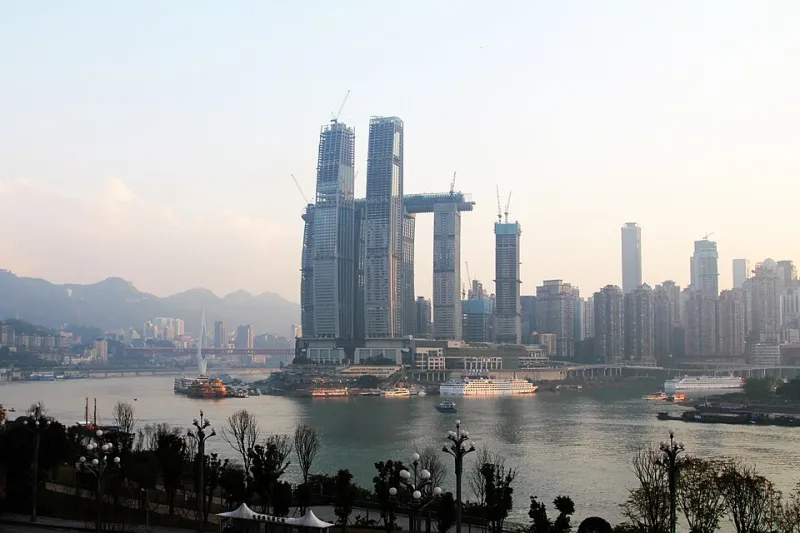
Photo: Junyi Lou, CC BY-SA 4.0, via Wikimedia Commons
There's a version of China that shows up in every travel magazine: the Great Wall at dawn, the skyline of Pudong, the lantern-lit alleyways of a perfectly preserved ancient town. It's beautiful. It's also increasingly curated for outside consumption.
Then there's the other China — the one that makes the phones, builds the bridges, trains the engineers, and feeds the factories. It's noisier, less photogenic on first glance, and almost entirely off the itineraries of American tourists. It's also, arguably, the most honest window into what China actually is right now.
If you want to understand modern Chinese life rather than just observe its highlights, start looking at the cities most travelers fly over on their way somewhere else.
Why Industrial Cities Are the Real Story
China's coastal tourist circuit — Beijing, Shanghai, Xi'an, Guilin — is extraordinary. But it's also well-worn. The experiences there have been refined for international visitors over decades, which means you're often seeing a version of China that's been somewhat smoothed at the edges.
Secondary cities don't have that layer of polish. They're built for the people who live in them, not for visitors passing through. That means the restaurants serve what locals actually eat, the neighborhoods reflect how people actually live, and the pace of development is visible in real time — cranes and century-old storefronts sharing the same block.
These cities are also where the economic story of modern China becomes legible. The manufacturing boom, the tech expansion, the migration from rural provinces, the emergence of a massive middle class — you can read all of this in the streets of Wuhan or Dongguan in a way that's simply not possible in the tourist-facing districts of Shanghai.
Wuhan: More Than a Dateline
For most Americans, Wuhan is a name associated with a single moment in history. That association is understandable and also deeply incomplete.
Wuhan is a city of eleven million people, a major transportation hub, and one of China's most significant centers for higher education and biomedical research. It sits at the confluence of the Yangtze and Han rivers, which means it has the kind of dramatic waterfront geography that other cities spend fortunes trying to manufacture.
The city's Hankou district — one of three historic areas that merged to form modern Wuhan — retains a remarkable collection of early 20th-century European-style architecture from its days as a treaty port. Walking those streets feels like stumbling into a parallel-universe Shanghai that never got famous. The food scene is serious: hot dry noodles (re gan mian) are a local obsession, and the breakfast culture here is worth waking up early for.
Wuhan also has a genuinely vibrant student population — over a million university students call the city home — which translates into a live music scene, independent bookshops, and a café culture that doesn't feel staged for anyone's benefit.
Chongqing: The City That Rewrites Your Expectations
Chongqing is technically one of the largest cities in the world by administrative area, which is a bureaucratic fact that obscures what makes it remarkable: it's built vertically, on hillsides, across rivers, in ways that defy conventional urban logic.
Monorail lines pass through the middle of residential buildings. Elevators function as public transit between street levels separated by a hundred feet of elevation. The topography forces a kind of creative density that makes Chongqing look, in places, like a city from a science fiction film — except everyone's just going to work.
The food is exceptional and genuinely spicy in a way that Sichuan cuisine outside of this region rarely is. Chongqing hotpot — served with a broth that's essentially liquid fire — is a communal, hours-long experience that tells you more about Chinese social culture than any museum exhibit. Sit down with a group, order too much, and stay until your lips go numb.
For American visitors interested in urban design, infrastructure, or just the experience of being in a city that doesn't resemble anything back home, Chongqing is extraordinary.
The Pearl River Delta Beyond Shenzhen
Shenzhen itself has graduated to a kind of tech-tourist destination — the place where Westerners come to gawk at Huaqiangbei electronics market and marvel at the speed of Chinese innovation. It's worth a visit. But the cities immediately surrounding it are where the actual manufacturing ecosystem lives.
Dongguan, Foshan, and Zhongshan are not glamorous names. They're not supposed to be. These are cities where goods that fill American homes are designed, prototyped, and produced. Visiting them isn't about factory tourism (though that's occasionally possible through organized programs) — it's about seeing the physical infrastructure of global trade and understanding the scale of what happens here.
Foshan in particular has been investing heavily in its own cultural identity, leaning into its history as the birthplace of Wing Chun kung fu and a center for Cantonese opera. The contrast between its ceramic-tile manufacturing districts and its preserved ancestral temples is jarring and fascinating in equal measure.
How to Actually Navigate These Cities
The practical reality of visiting non-tourist cities in China is that you'll need to be more self-sufficient than in Beijing or Shanghai. English signage is less common. Staff at hotels and restaurants may not speak English. Google Maps doesn't work in China, so download Baidu Maps or Gaode Maps before you arrive, and get comfortable with screenshot-translating Chinese text through an app like Google Lens (which works offline).
High-speed rail connects most of these cities efficiently and cheaply. A ticket from Wuhan to Chongqing, for instance, runs a few hours and costs a fraction of what a comparable American train journey would. The rail network is genuinely one of China's great achievements, and using it is the best way to understand the physical scale of the country.
Stay in business hotels rather than international chains — the price difference is significant, the quality is comparable, and you'll be surrounded by domestic travelers rather than other tourists.
The Point of Going
Visiting China's overlooked industrial cities isn't about discomfort tourism or proving something to yourself. It's about intellectual honesty. If you want to understand the country that will define much of the 21st century, you need to see more than its curated highlights.
The cities that build things, train engineers, move goods, and house the people doing all of that work — these are the cities where modern China is actually happening. They're less convenient to visit. They reward curiosity over comfort. And they'll leave you with a more complicated, more accurate, and ultimately more interesting picture of a country that deserves to be understood on its own terms.