Camel Bells and Clay Cities: How the Silk Road Is Becoming the Most Meaningful Trip You Can Take in China
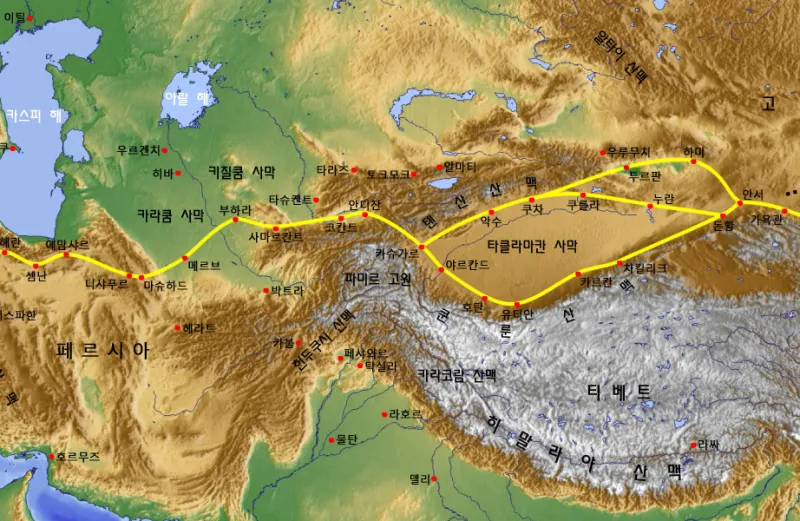
Photo: Silk_Road_ko.jpg: Jyusin derivative work: 배우는사람 (talk), CC BY-SA 3.0, via Wikimedia Commons
There's a moment somewhere between Xi'an and Dunhuang — maybe you're standing in a canyon carved by a river that dried up a thousand years ago, or watching a Uyghur baker pull flatbread from a clay oven — when the history stops being abstract. It stops being something you read about in a high school textbook and starts being something you're inside of. That's what the Silk Road does to you. And right now, more Western travelers than ever are figuring that out.
China's ancient trade routes don't get the same Instagram attention as the Great Wall or the karst peaks of Guilin. But that's changing — and honestly, the timing couldn't be better.
Why the Silk Road, and Why Now
For a long time, the classic China itinerary for Americans looked pretty predictable: Beijing, Shanghai, maybe a river cruise through the Three Gorges. Those are great trips. Nobody's saying otherwise. But there's a growing crowd of travelers — people who've maybe already done one China visit, or who are just tired of monument-collecting — who want something more layered.
The old trade routes deliver that in a way that's hard to replicate. The Silk Road wasn't a single road. It was a sprawling network of corridors connecting China to Central Asia, Persia, and eventually Rome, carrying silk, spices, ideas, religion, and disease across thousands of miles. That complexity is still visible today if you know where to look.
And increasingly, small-group tour operators and independent travelers are building itineraries around exactly that.
Starting in Xi'an: Where the Road Actually Begins
Most people know Xi'an for the Terracotta Warriors, and yes, you should see them. But Xi'an is also the eastern terminus of the Silk Road, and the city itself is a living document of that history. The Muslim Quarter — a dense, aromatic neighborhood built around the Great Mosque — has been there in some form since the Tang Dynasty, when Arab and Persian merchants settled here and never quite left.
Wander through at dinner time and you'll find lamb skewers, pomegranate juice, and vendors selling persimmon cakes in a scene that feels genuinely Middle Eastern in the middle of northwestern China. That's not an accident. That's seven centuries of cultural overlap made edible.
Spend at least two full days in Xi'an before heading west. The Shaanxi History Museum alone is worth half a day and gives you the context to understand everything that comes after.
Heading into the Corridor: Gansu Province
The Hexi Corridor — a narrow strip of land between mountain ranges in Gansu Province — is where the Silk Road gets dramatic. This is the geographic bottleneck that all westbound trade had to pass through, and the towns along it still carry that weight.
Zhangye is famous for its rainbow-colored Danxia landforms, which look like something a science fiction set designer would dream up. But the city also has a massive reclining Buddha statue that dates back to the Western Xia dynasty, and its night market is one of the most underrated food experiences in all of China. Try the beef noodles. Don't skip the yogurt.
Further west, Jiayuguan marks the western end of the Ming-era Great Wall — the point beyond which imperial China considered itself to end and the wilderness to begin. Standing at the fort at dusk, looking out at the Gobi stretching toward Central Asia, you get a genuine sense of what it meant to be at the edge of the known world.
Dunhuang: Where Desert Meets Devotion
If there's one stop on this route that tends to convert skeptics into true believers, it's Dunhuang. This small oasis city in the Gobi Desert was a critical waystation for merchants, monks, and pilgrims for over a thousand years. The Mogao Caves — a UNESCO World Heritage Site — contain some of the most extraordinary Buddhist art on earth: 492 caves filled with murals and sculptures spanning ten dynasties.
You need to book cave access in advance. The standard ticket gets you into a selection of caves with a guide; for the most significant caves, you'll need to pay for a special access ticket. It's worth every penny.
Outside the caves, the Crescent Lake — a spring-fed pond surrounded by enormous sand dunes — is the kind of landscape that makes you feel like you've hallucinated it. You can rent a camel at sunrise for a dune ride that's genuinely, surprisingly moving.
Xinjiang: The Furthest West
Extending the route into Xinjiang — specifically to Kashgar in the far west — adds significant travel time and logistical complexity, and it's worth doing your research on current travel conditions before committing. That said, Kashgar's old city and its Sunday livestock market represent a cultural experience that has almost no equivalent elsewhere in China. The city sits at the crossroads of Chinese, Central Asian, and South Asian influences in a way that's immediately disorienting and completely fascinating.
If Xinjiang feels like too much for a first trip, Turpan — closer to Urumqi and more accessible — offers ancient underground irrigation systems, ruined cities, and some of the sweetest grapes you'll ever eat. It's a softer entry point into the region.
How to Actually Do This Trip
High-speed rail has transformed travel along parts of this corridor. Xi'an to Lanzhou, Lanzhou to Zhangye, Zhangye to Dunhuang — much of it is now accessible by fast train, which makes self-guided travel genuinely feasible. That said, a small-group tour with a knowledgeable local guide adds enormous value on a route where historical context is everything.
Budget at least two weeks if you want to move at a pace that allows for genuine exploration. The best moments on this route — a conversation with a Gansu noodle maker, stumbling into a village festival, watching the stars over the Gobi — don't happen on a rushed schedule.
Bring layers. The desert temperature swings are no joke. And leave room in your bag, because the textiles, dried fruits, and crafts you'll find along this route are the real souvenirs of a trip that doesn't feel like tourism at all.